


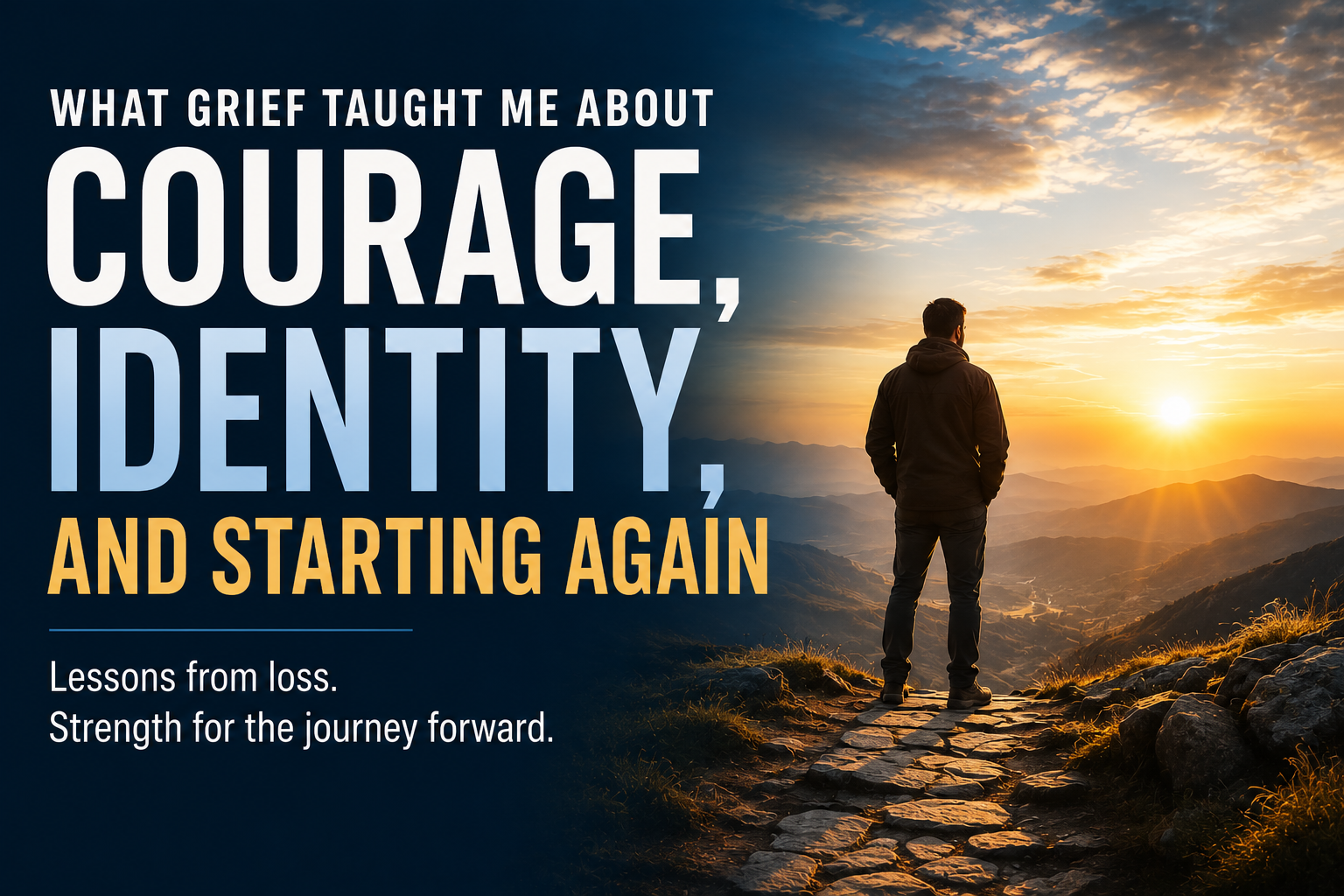
We often think of courage as something dramatic.
Standing on a stage. Making a bold decision. Taking a significant risk.
But in my experience, courage rarely looks like that.
More often, courage is quiet.
It’s getting out of bed when your world has been turned upside down. It’s showing up for your family when you’re struggling yourself. It’s taking the next step when you have no idea where the path leads.
Recently, I had the opportunity to share some of my journey on a podcast conversation about grief, identity, resilience, and what it means to rebuild after life’s most difficult moments.
The conversation reminded me of a truth that many of us eventually face:
Life doesn’t always unfold according to plan.
When Life Changes in an Instant
Most of us build our identity around things that feel stable.
Our career.
Our relationships.
Our health.
Our routines.
Our future plans.
But what happens when one of those foundations suddenly disappears?
Loss has a way of stripping away certainty. It forces us to confront questions we may never have asked before:
- Who am I now?
- What matters most?
- How do I move forward?
- What does success even mean anymore?
These aren’t easy questions. In fact, they can be deeply uncomfortable.
Yet they are often the questions that lead to our greatest growth.
Grief Is Not Something You “Get Over”
One of the biggest misconceptions about grief is that it follows a timeline.
People often expect healing to happen neatly and predictably.
The reality is very different.
Grief isn’t a problem to solve. It’s an experience to navigate.
Some days feel manageable.
Other days can bring emotions flooding back unexpectedly, even years later.
What I’ve learned is that healing isn’t about forgetting.
It’s about learning how to carry what you’ve lost while continuing to live fully.
The goal isn’t to return to who you were before.
The goal is to become who you’re capable of being now.
The Hidden Connection Between Grief and Growth
Most of us wouldn’t choose adversity.
We wouldn’t volunteer for heartbreak, disappointment, or loss.
Yet many people can look back on difficult chapters and recognise that those experiences shaped them in profound ways.
Not because suffering is inherently valuable.
But because struggle often reveals strengths we didn’t know we possessed.
It teaches patience.
It builds resilience.
It deepens empathy.
It clarifies priorities.
And perhaps most importantly, it helps us appreciate what truly matters.
Growth doesn’t erase pain.
But it can coexist with it.
Courage Is Smaller Than We Think
When people hear the word courage, they often imagine extraordinary acts.
But I believe courage is found in ordinary moments.
It’s having a difficult conversation.
It’s asking for help.
It’s being honest about how you’re really doing.
It’s choosing vulnerability instead of pretending everything is fine.
It’s taking one step forward when fear tells you to stay where you are.
These moments rarely make headlines.
Yet they are often the moments that change lives.
Rebuilding Your Identity After Loss
One of the most challenging aspects of grief and major life transitions is the impact they have on identity.
When a role, relationship, dream, or chapter ends, it can leave us questioning who we are.
Many people try to return to the person they were before.
But sometimes the journey isn’t about going back.
Sometimes it’s about becoming someone new.
This requires curiosity.
It requires patience.
And it requires giving yourself permission to evolve.
The person you become after adversity may not look exactly like the person you were before.
That doesn’t mean you’ve lost yourself.
It may mean you’re discovering a deeper version of yourself.
What Courage Looks Like Today
Today, I define courage differently than I once did.
It’s not about having all the answers.
It’s not about being fearless.
It’s not about always appearing strong.
Courage is staying present.
Courage is telling the truth.
Courage is continuing to move forward when the future feels uncertain.
Most importantly, courage is recognising that you don’t have to walk through life’s challenges alone.
Connection, community, and honest conversation are often where healing begins.
Final Thoughts
If you’re currently navigating grief, loss, uncertainty, or a major life transition, know this:
You don’t need to have everything figured out.
You don’t need to move at anyone else’s pace.
You don’t need to be “over it.”
Just focus on the next step.
Then the one after that.
Because courage isn’t found in knowing exactly where you’re going.
It’s found in being willing to keep moving forward.
And sometimes, that’s more than enough.
Watch the full podcast conversation here:
📺 https://www.youtube.com/watch?v=t3TFfKgc3bc
About Kevin Holloway
Kevin Holloway is the co-founder of Courageous Leaders, helping individuals and organisations build stronger leadership, deeper connections, and the courage to navigate life’s challenges with authenticity and purpose.