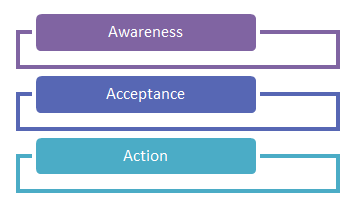



It is critical to recall from earlier blogs in this series that feedback brings awareness, not action, because when giving it effectively this is an important context for your conversation:
Definition of feedback
Feedback is describing other’s behaviours and outcomes achieved in order to reinforce positive progress or be constructive and assist in the future development of the person. Feedback is all about replaying what they did and what they achieved in a specific situation and describing the impact it had on you, the outcome and the team – only if you personally witnessed the impact on the team.
When giving feedback  visualise it as holding up a mirror so the other person can see and hear what you have been seeing and hearing. Just like the mirror we check out before we leave the house remember that people may not always like what they see. I would say it is always important to approach their initial response with patience and kindness; and yet remain vigilant with your focus and your truth.
“…..aspiring (leaders) must analyse what worked and what didn’t and view each new experiment (with their behaviours) as bringing them closer to reaching their goal………The speed and outcome of this process depends on the quality of self reflection and the quality of the feedback….received.” ~ Herminia Ibarra
Positive or developmental
For feedback to be effective you need to use both developmental and positive and we recommend you take the “Courageous Leaders challenge” and provide 5 pieces of positive feedback for every one piece of developmental feedback you give over a month – this ratio encourages and enables high performance.
Remember people need feedback – they need to know how others see their performance and appreciate their contributions…they need the “good and the bad”…..better known as positive and developmental feedback. Appreciate people don’t equate silence as a sign they have done a good job – they need to hear it from you in a very specific way about a very specific situation!
Make it specific
For both positive and developmental feedback to be effective it needs to be specific. General feedback is useless (and damaging) for the person receiving it.
For example general feedback like:
“You are a good listener” is meaningless because while the person knows and likes they have received the label of good listener; they have no idea what they did to earn this label. Therefore they have no certainty on how to replicate this performance and continue to earn this label.
We recommend you give them highly specific feedback – like:
“When I was talking in the meeting I noticed you:
• Nodding to show agreement
• Questioning to clarify
• Summarising what I had said at appropriate times.
This made me feel like you were really listening to me and the impact is I value talking to you and having you involved in meetings with me.”
Important to observe people
To give highly specific feedback like this you have to observe people and gather evidence to support the evaluation and judgement you make in your head – like that person is a good listener or they are a good team player….what evidence do you have to support this conclusion – and that is your feedback! When gathering such evidence use this acronym to remind you to seek out data and observations that are:
C complete
A accurate
V valid
E exists.
Use the AIID process to give feedback effectively
AIID is the process we suggest everyone gets skilled in using consistently to provide effective feedback:
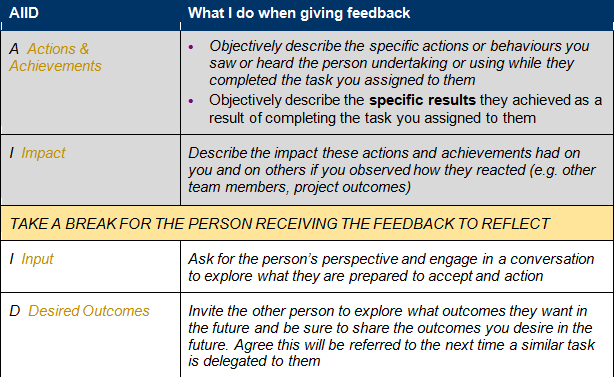
When engaged in a feedback conversation the focus is on ACTIONS and IMPACT. We recommend you halt the conversation after the impact has been explored as the person receiving the feedback takes time to reflect on the messages before they provide input and hear about the desired outcomes.
If you need detailed checklists to support this process let us know; or even a one day workshop to “learn the skills” using real world examples. Engage in a conversation with us to explore more.